
If your student’s SAT score is not improving, the problem may not be effort.
Many students do the “right” things on paper. They buy prep books. They take practice tests. They try tutoring. They sit through a class or bootcamp. They may even study for hours every week.
But the score still barely moves.
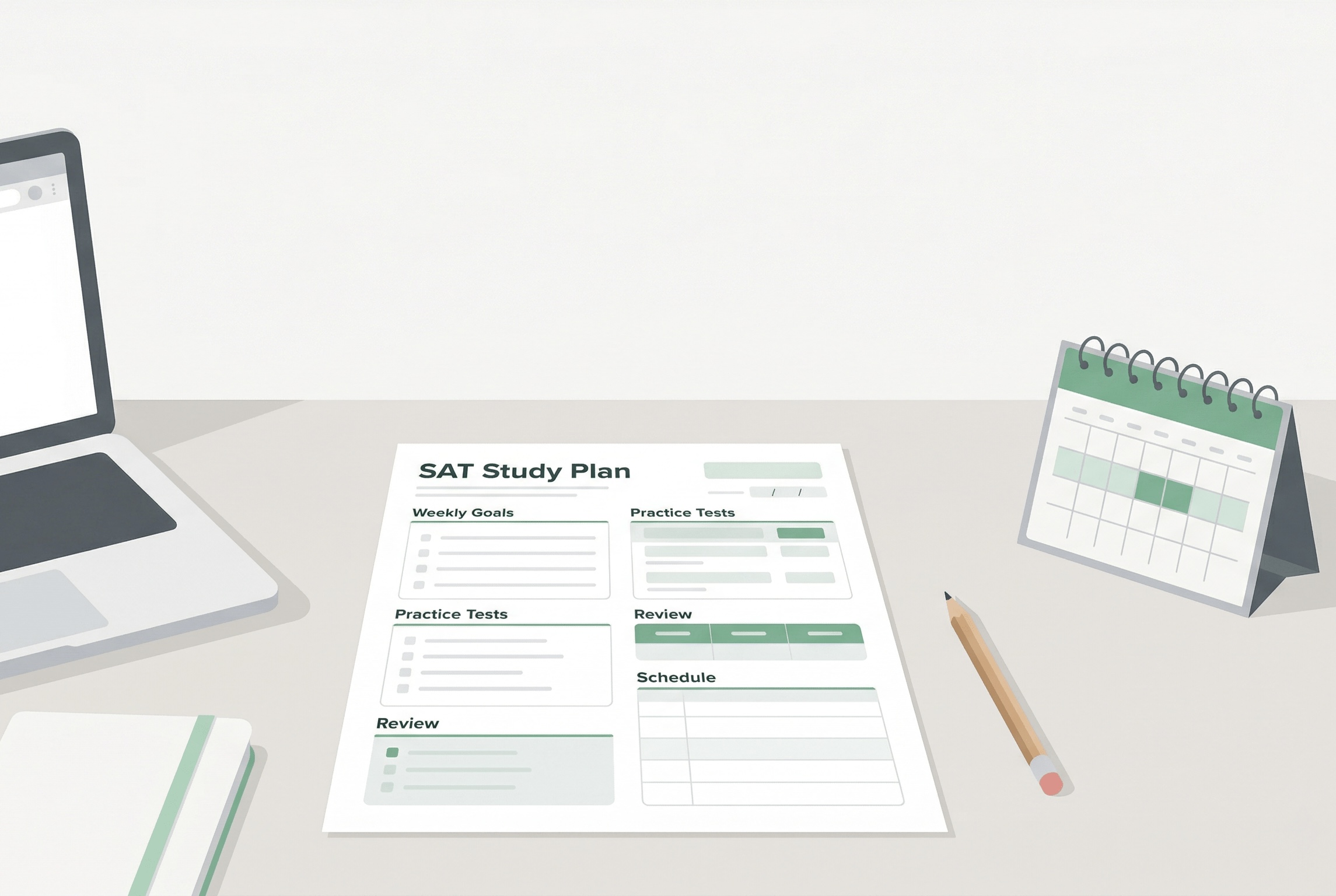
That usually means the student does not just need more SAT prep. They need a clearer SAT plan.
A good plan should answer four questions every week:
- What score are we aiming for?
- What is currently holding the student back?
- What exact practice should happen before the next session?
- How will we know if the plan is working?
Without those answers, SAT prep can turn into a loop of random practice, vague feedback, and repeated mistakes.
At LearnHaus, we see this most often with students in the 1200s and 1300s. They are capable. They know a lot of the material. But they keep losing points from timing, careless errors, weak review habits, or not knowing which section to prioritize.
That is fixable, but not by guessing.
Short answer: why SAT prep stops working
SAT prep usually stops working when students are doing practice without a system.
That can look like:
- Taking practice tests but not deeply reviewing missed questions
- Studying every topic instead of the highest-impact weak areas
- Practicing untimed but struggling on the real test
- Missing the same question types again and again
- Not knowing whether Math or Reading and Writing should be the priority
- Getting tutoring help but no clear weekly targets
- Parents having no visibility into what is actually improving
The fix is not always more hours. The fix is a tighter feedback loop.
That means a baseline score, a target score, a weekly plan, assigned practice, mistake-pattern review, pacing strategy, and clear updates.
LearnHaus SAT prep is built around that kind of structure: 1:1 tutoring, weekly targets, mistake tracking, and parent visibility.
The Digital SAT makes planning more important
The SAT is now shorter, digital, and adaptive.
According to the College Board’s SAT structure page, the Digital SAT has two sections: Reading and Writing, and Math. Each section has two timed modules.
Reading and Writing has 54 questions across 64 minutes. Math has 44 questions across 70 minutes. The full test takes 2 hours and 14 minutes, plus a break.
Because the test is adaptive, a student’s performance in the first module affects the difficulty of the second module in that section. That means pacing and accuracy early in the test matter.
Students can use official tools like Bluebook practice tests and Khan Academy’s SAT prep resources, and those tools can be genuinely useful.
But tools alone do not create a plan.
A student can take a full Bluebook test, see a score, and still not know what to do next.
That is where many families get stuck.
Why motivated students still plateau
A score plateau does not always mean a student is lazy.
Sometimes it means the student is working, but the work is not targeted enough.
Here are the most common reasons SAT scores stop improving.
1. The student is taking practice tests without reviewing deeply
Practice tests are helpful, but they are not magic.
A practice test should create a plan. It should not just create a number.
After each test, the student should know:
- Which section lost the most points
- Which question types showed up repeatedly
- Which misses were content gaps
- Which misses were timing problems
- Which misses were careless errors
- Which topics should be assigned next
If the student just checks the score and moves on, the same errors usually repeat.
A better approach is to build a simple mistake log. For each missed question, the student should write:
- What topic was tested?
- Why did I miss it?
- Was it content, timing, careless error, or strategy?
- What should I do differently next time?
This is not complicated. It is just rarely done consistently.
2. The practice is too broad
Many students study “SAT Math” or “SAT Reading and Writing” as if those are small topics.
They are not.
A student might be strong in linear equations but weak in advanced algebra. They might be fine with grammar rules but lose points on transitions, rhetorical synthesis, or main idea questions. They might understand the content untimed but lose accuracy when the clock is running.
Broad practice feels productive, but it often hides the real issue.
A clearer plan might say:
- This week, Math focus is advanced algebra and nonlinear equations.
- Reading and Writing focus is transitions and command of evidence.
- Timing focus is flagging slow questions after 45 seconds.
- Practice target is two timed modules plus review.
- Parent update should explain what improved and what still needs work.
That is much more useful than “do more SAT practice.”
3. The student does not know what to prioritize
Some students are close to their target score but do not know where the next 50 to 100 points should come from.
That was part of the issue for Walker, a Florida student who came to LearnHaus after trying several other prep options.
Walker had a 1330 superscore and wanted to reach the 1400s. His family had tried in-person tutoring, online prep, a bootcamp, and SAT books. He was motivated, but his score kept hovering in the same range.
The problem was not that he refused to work.
The problem was that he did not have a clear enough plan for what would actually move the score.
After starting with LearnHaus, Walker worked with his SAT tutor, Alex, twice per week. They reviewed score history, focused on mistake patterns, and built a more targeted approach around pacing, Math, Reading and Writing strategy, and consistent practice.
After his first session, his parent shared:
“Walker had his first session with Alex and it was EXCELLENT! Perfect fit and Walker said this is the first place that has actually given me a plan to study and to attain a better score!”
About a month later, Walker improved from a 1330 to a 1430.
His parent wrote:
“Walker went from a 1330 to a 1430 which was his goal! You have a very solid program!”
And later:
“We had spent thousands at in person. On line etc, no results until we signed up with you!”
This is one student’s experience, shared with permission. Results vary based on starting score, timeline, attendance, assigned practice, and test-day performance.
The lesson is not that every student jumps 100 points in a month.
The lesson is that Walker did not need more random prep. He needed a better system.
Read Walker’s full SAT case study.
4. Timing and pacing are treated like an afterthought
Many students understand the content better than their score shows.
They lose points because they:
- Spend too long on hard questions
- Rush the last few questions
- Forget to flag and return
- Try to solve every question perfectly
- Make careless mistakes under time pressure
- Panic when a question looks unfamiliar
On the Digital SAT, pacing matters because each module is timed, and students cannot go back to the previous module once it ends.
A practical pacing plan should include:
- A first-pass strategy
- A rule for when to guess, flag, and move on
- A target amount of time per question type
- A review routine for rushed mistakes
- Timed practice, not just untimed review
For many students in the 1200s and 1300s, the difference between “I know this” and “I scored well” is execution under pressure.
5. Parents cannot see whether prep is working
A lot of SAT prep puts the burden on the parent.
The parent has to ask:
- Did you study?
- What did the tutor cover?
- Are you improving?
- What are you doing before the next test?
- Should we register for another SAT?
- Do we need more help or less help?
Most teenagers answer these questions with some version of “it’s fine.”
Parents do not need to micromanage every assignment. But they do need visibility.
A strong SAT plan should give parents simple answers:
- What was covered this week?
- What did the student do well?
- What still needs work?
- What practice is assigned next?
- Is the student on pace for the next test date?
That is why LearnHaus includes session summaries and, on higher-touch SAT plans, Friday parent updates.
The goal is not to flood parents with emails. The goal is to make progress visible without adding another meeting to the calendar.
What a clear SAT plan should include
A clear SAT plan does not need to be complicated.
It should include these pieces.
1. A baseline score
Start with a real score.
That can come from:
- An official SAT
- A PSAT
- A full-length Bluebook practice test
- A recent diagnostic
The baseline should include section scores, not just the total score.
A 1280 with 700 Math and 580 Reading and Writing is a different plan from a 1280 with 620 Math and 660 Reading and Writing.
2. A target score
The target should be tied to something real:
- Bright Futures
- A college list
- A scholarship goal
- A personal benchmark
- A specific upcoming test date
For Florida families, SAT planning often connects to Bright Futures. Families may be watching whether a student is near a scholarship threshold, a college target, or both.
That is why “just improve” is not a plan.
A student who needs 50 points has a different plan from a student who needs 180.
3. A test timeline
A SAT plan should work backward from the next real test date.
Ask:
- When is the next SAT?
- Is there enough time for 4, 6, or 8 weeks of focused prep?
- Is this the first attempt, a retake, or a final push?
- Are there college application or scholarship deadlines involved?
A student with 12 weeks has room to rebuild habits. A student with 3 weeks needs triage.
Both can make progress, but they need different plans.
4. Weekly targets
Each week should have a narrow focus.
Examples:
- Complete one timed Reading and Writing module
- Review all transition and command of evidence misses
- Drill advanced algebra for 45 minutes twice this week
- Complete one Math module under test timing
- Add every missed question to the mistake log
- Review pacing errors before the next session
The point is to make practice specific enough that the student knows what to do without guessing.
5. Mistake-pattern review
The best SAT prep is not just about what the student gets wrong.
It is about why the student gets it wrong.
Common mistake types include:
- Content gap
- Misread question
- Careless arithmetic
- Rushed answer
- Trap answer
- Weak elimination strategy
- Timing issue
- Did not know when to skip
Once the pattern is clear, the plan can change.
That is the loop: practice, review, identify pattern, adjust next week.
6. Pacing strategy
Students should not treat every question the same.
A good pacing plan teaches the student how to:
- Move quickly through easier questions
- Flag questions that are taking too long
- Avoid spending three minutes on one low-probability question
- Use the built-in calculator wisely
- Leave time to check answers
- Finish each module with fewer rushed guesses
For many students, pacing is not a personality trait. It is a skill.
7. Parent visibility
Parents should not have to guess whether the plan is working.
A simple parent update can include:
- This week’s focus
- What improved
- What still needs work
- Assigned practice
- Whether the student is on track
- What happens next
This is especially helpful when families have a deadline, a target score, or a scholarship goal.
When self-study might be enough
Self-study can work for some students.
It may be enough if your student:
- Is already consistent
- Reviews every mistake carefully
- Knows exactly which skills to target
- Can build their own weekly plan
- Stays calm under timed practice
- Has enough runway before the next SAT
In that case, official practice through Bluebook and Khan Academy can be a strong starting point.
But self-study often breaks down when the student is motivated but not organized.
That is when a structured 1:1 plan can help.
When tutoring makes more sense
SAT tutoring is more useful when:
- The score is stuck after multiple tests
- The student does not know what to prioritize
- Practice is happening but not translating into score movement
- Timing is a recurring issue
- Parents need visibility
- There is a specific deadline or scholarship target
- The student needs accountability between sessions
That is the situation LearnHaus is built for.
Not every student needs a tutor forever. But many students need a focused stretch of help to turn scattered practice into a plan.
Preview your SAT plan or learn more about LearnHaus SAT prep.
A simple parent checklist
If your student’s SAT score is not improving, ask these questions:
- Do we know the exact target score?
- Do we know the next test date?
- Do we know which section is costing the most points?
- Do we know the top 3 mistake patterns?
- Is practice timed?
- Is there a weekly assignment plan?
- Is someone reviewing missed questions deeply?
- Are we tracking progress by skill, not just total score?
- Do parents get updates without having to ask?
- Is the student repeating the same mistakes?
If the answer is mostly no, the issue is probably not effort.
The issue is the system.
FAQ
Why is my student’s SAT score not improving?
Usually, the score is not improving because the student is practicing without a clear feedback loop. They may be taking tests or doing problems, but not reviewing mistakes deeply enough to identify patterns and adjust the next week’s work.
Is more SAT practice always the answer?
No. More practice helps only if it is targeted. If a student keeps practicing the wrong things or reviewing too shallowly, more hours can still lead to the same score.
Can Khan Academy and Bluebook be enough?
Yes, for some students. Official practice tools are valuable, especially when students use them consistently and review mistakes carefully. But some students need help turning those tools into a weekly plan with accountability and pacing strategy.
How often should my student study for the SAT?
It depends on the target score and timeline. Many students do better with consistent weekly practice instead of cramming. A realistic plan usually includes assigned practice between sessions and time for review.
What should parents look for in SAT tutoring?
Look for a plan, not just a tutor. Ask whether the program includes score review, weekly targets, assigned practice, mistake tracking, pacing strategy, and parent updates.
Can a student improve 100 points?
Some students can, especially with enough runway, consistent practice, and a focused plan. But results vary based on starting score, timeline, attendance, assigned practice, and test-day performance. Avoid any program that makes score gains sound automatic.
Final takeaway
If SAT prep is not working, do not assume your student is lazy.
They may be missing the structure that turns effort into progress.
The strongest SAT plans are not built around random practice. They are built around a clear target, a real timeline, weekly assignments, mistake-pattern review, pacing strategy, and parent visibility.
That is what helped Walker move from 1330 to 1430 after his family had already tried other prep options.
And it is the same reason LearnHaus focuses on managed SAT prep instead of leaving families to coordinate everything themselves.
Get your student’s SAT plan or see LearnHaus SAT tutoring options.